How do I pick the correct winding machine when I already have finished coil samples? Many coil manufacturers face the same question:
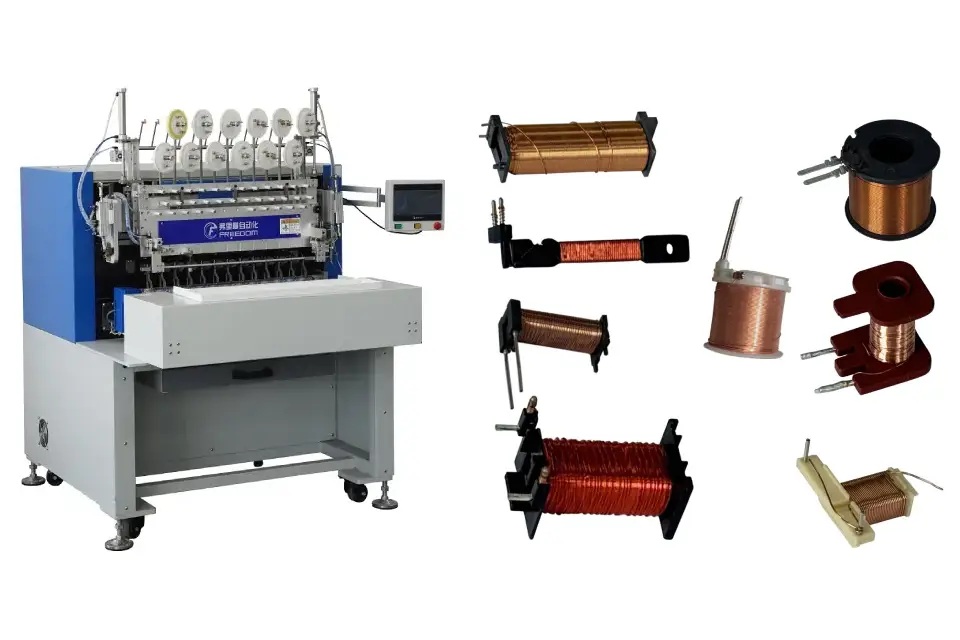
As shown in the picture: our multi-spindle automatic coil winding machine (on the above) is specially developed for producing various small electronic coils displayed on the right, including inductor coils, transformer coils, filter coils, horizontal pin coils, vertical lead coils and special-shaped bobbin coils.
Your finished coil is the most important reference standard to decide which winding equipment fits your production line. The size, pin structure, wire diameter, winding quantity and batch output of your coil directly determine the machine configuration you need.
We have sorted out practical tips for you to match coils with winding machines.
1. Check your bobbin / coil skeleton structure first
Look at your coil sample:
- Does it adopt horizontal pins or vertical lead-out wires?
- Is it a plastic bobbin, a shielded frame or a self-bond air coil?
Multi-spindle CNC winding machines work perfectly for bobbins with fixed terminals. If you produce dozens of identical bobbin coils in large batches, multi-axis winding equipment will greatly improve your efficiency compared with single-spindle machines.
2. Confirm enamelled wire diameter range
Wire gauge is a critical parameter.
Our multi-axis coil winding machine supports fine to medium enameled copper wire, ideal for small transformer coils, signal inductors and power inductors.
If you use ultra-fine wire below 0.05mm or thick heavy wire above 1.2mm, you need to select a dedicated model with customized wire feeding and tension mechanism.
3. Calculate your daily production volume
- Small batch, frequent model changes: Single spindle winding machine is more flexible
- Stable mass production of the same coil type: Multi-spindle automatic winding machine brings obvious cost advantages. The machine in our picture can wind multiple coils simultaneously, which cuts labor cost and improves consistency for mass orders.
4. Tolerance and winding precision requirements
Electronic coils for sensors, medical electronics and power supplies require tight winding tolerance.
CNC controlled multi-axis winding equipment supports precise layer winding, uniform wire arrangement, reducing defective rate caused by messy winding.
5. Can your coil support automated unloading?
If your production requires continuous automatic operation, we can configure automatic unloading mechanism for the multi-spindle winder. For low-volume prototypes, manual unloading mode is enough to control investment cost.
Who can benefit from this multi-spindle coil winding machine?
Factories producing the following coil types are highly matched:
- Horizontal pin inductor coils
- Small power transformer coils
- Filter inductance coils
- Sensor coils
- Various bobbin wound copper coils
Final Advice
If you are not sure which winding machine matches your coil samples, send us clear photos or physical samples of your finished coils. Our engineering team can evaluate wire diameter, winding turns, bobbin size and output demand, then recommend the most cost-effective automatic coil winding solution for you.
