Overview
Electrical coils are the foundational electromagnetic components found in nearly all electronic devices, automation systems, power equipment, and industrial machinery. For manufacturers, electrical engineers, and production technicians, understanding different coil types and their winding standards is critical for improving product performance, stability, and production efficiency.
Each coil type is designed for specific working principles, frequency ranges, and mechanical functions. Differences in core material, wire gauge, winding turns, and winding precision directly determine the final quality of inductance, magnetic output, heat dissipation, and service life. As a professional coil winding machine manufacturer, we will systematically introduce the most common electrical coil types and their corresponding production requirements.
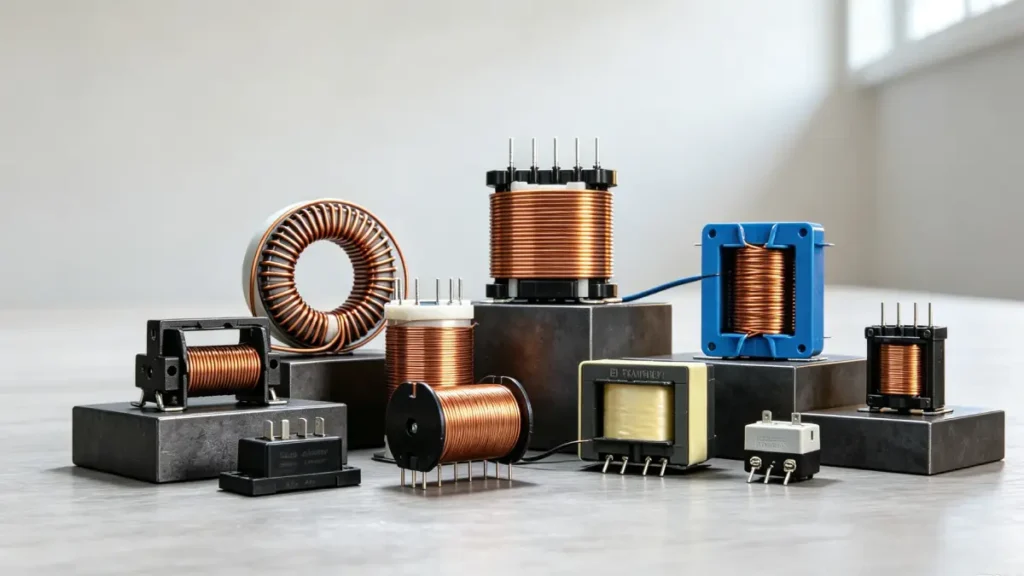
What Is an Electrical Coil?
An electrical coil consists of insulated conductive wire (mainly copper wire and aluminum wire) wound into a fixed structural shape. When current passes through the wire, a stable magnetic field is generated. By matching different core materials and winding structures, coils can realize energy storage, magnetic conversion, signal filtering, power transmission, and mechanical driving functions.
Coils can be wound on air cores, iron cores, laminated steel sheets, and plastic bobbins. Different structural designs adapt to low-frequency power equipment, high-frequency electronic circuits, precision sensing devices, and industrial automation equipment. Therefore, coil winding is never a unified standard process — every product needs customized winding precision and process control.
Why Precision Coil Winding Matters for Industrial Production
All electrical equipment relies on the stable electromagnetic conversion of coils. Poor winding consistency, uneven wire arrangement, unstable tension, and inaccurate turn counts will lead to unstable inductance, excessive heat generation, inconsistent magnetic force, and even product failure.
High-quality coil winding requires strict control of wire tension, winding speed, layer alignment, turn count accuracy, terminal processing, and insulation protection. Automated coil winding equipment effectively solves the problems of low manual efficiency and inconsistent product quality, and is the core guarantee for mass production of various electrical coils.
Common Types of Electrical Coils & Application Characteristics
1. Solenoid Coils
Solenoid coils are cylindrical wound coils specially used for electromagnetic drive. After energization, they generate stable magnetic attraction to drive valve cores, mechanical armatures, and switch structures to complete linear actions.
Widely applied in solenoid valves, industrial actuators, relays, door locks, pneumatic and hydraulic control systems, and automotive electronic systems. Solenoid coils require dense and uniform winding, stable tension, and good high-temperature insulation performance to adapt to long-term intermittent work.
2. Inductor Coils
Inductor coils are core components for energy storage and current stabilization in circuits. They resist current changes, filter clutter, and stabilize voltage. They are widely used in switching power supplies, DC-DC converters, EMI filters, audio circuits, and RF communication equipment.
Inductor coils include air-core and iron-core structures. High-frequency inductors require neat and flat winding to reduce high-frequency loss, while power inductors need thicker wire diameters and high saturation resistance.
3. Transformer Coils
Transformer coils include primary and secondary windings, which rely on electromagnetic induction to realize voltage transformation and electric energy transmission. They are the core components of power distribution equipment, power adapters, battery chargers, and isolation circuits.
Transformer winding requires strict turn ratio control, layered winding, and reliable insulation. Uniform winding density can effectively reduce leakage inductance and heat generation, improving overall power conversion efficiency.
4. Motor Coils
Motor coils are used to generate rotating magnetic fields, converting electrical energy into mechanical rotation. They are widely used in AC and DC motors, brushless motors, stepper motors, servo motors, automated equipment, new energy vehicles, and household appliances.
Motor winding requires high slot filling rate, accurate wire arrangement, and strong vibration resistance. Automated winding equipment can effectively improve winding consistency and meet the requirements of high-volume motor production.
5. Relay Coils
Relay coils are small electromagnetic control coils used to control the opening and closing of high-power circuits through low-power signals. They are commonly used in industrial control cabinets, automotive circuits, safety protection systems, and HVAC equipment.
Such coils require stable pull-in voltage, sensitive response, and long-cycle fatigue resistance. Winding precision directly affects the stability and service life of the relay switch.
6. Toroidal Coils
Toroidal coils are wound on closed annular magnetic cores, featuring closed magnetic circuits, low magnetic leakage, low electromagnetic interference, and high efficiency. They are widely used in high-precision inductors, power filters, communication equipment, and high-end transformers.
Toroidal winding is more technically difficult than ordinary bobbin winding and requires professional toroidal winding machines to ensure uniform wire arrangement and consistent inductance parameters in mass production.
7. Choke Coils
Choke coils are professional anti-interference inductors, mainly used to suppress current ripple and filter electromagnetic noise, including common-mode chokes and differential-mode chokes. They are essential components in power supply anti-interference and electromagnetic compatibility design.
8. Special Functional Coils
Voice Coils: Used in speakers, precision linear actuators, and optical stabilization equipment, requiring ultra-precision winding and lightweight design.
Ignition Coils: Special transformer coils for engine ignition, withstanding high voltage and high vibration environments.
Sensor Coils: Used for magnetic field induction, speed detection, and position sensing, requiring extremely high winding consistency to ensure detection accuracy.
Electromagnetic Coils: Used for electromagnetic adsorption, braking, and separation in industrial equipment.
Core Factors Affecting Coil Winding Quality
No matter what type of coil, the final product quality depends on the precision control of the winding process:
- Stable wire tension to avoid wire breakage and loose winding
- Accurate turn count control to ensure consistent inductance
- Neat layer winding to reduce internal resistance and heat generation
- Standard terminal insertion, soldering, and taping process
- Complete electrical testing and insulation detection
Automated multi-axis winding equipment completely solves the pain points of low manual precision, inconsistent batches, and low efficiency, and is the best choice for medium and high-volume coil production.
How to Choose the Right Winding Solution for Different Coils
Different coil structures correspond to different winding equipment and processes:
- Bobbin coils & Solenoid coils: Suitable for multi-axis automatic winding machines, supporting high-speed mass production
- Toroidal coils: Professional toroidal winding equipment is required
- Motor stator coils: Special motor winding and inserting equipment
- High-precision inductors: Need low-tension, high-precision winding control system
FAQ
Q1: What are the most widely used coils in industrial manufacturing?
Solenoid coils, inductance coils, transformer coils, motor coils, and toroidal coils are the five most mainstream coil types, covering automation, power electronics, new energy, and automotive industries.
Q2: Why do mass-produced coils need automatic winding machines?
Automatic equipment ensures consistent turn count, uniform wire arrangement, stable tension, and qualified insulation, avoiding parameter deviation and failure rate caused by manual operation.
Q3: What coil types can your winding equipment produce?
Our equipment supports all mainstream coil windings, including solenoid coils, bobbin coils, toroidal coils, inductors, transformers, motor coils, and special precision coils, providing one-stop customized winding solutions.
Professional Coil Winding Machine Solutions From Freeman
As a professional manufacturer of automatic coil winding equipment, we focus on the R&D and production of high-precision, high-stability, and high-efficiency winding machines. We provide customized production solutions for different coil types, wire diameters, turn counts, and production capacity requirements.
Our equipment is widely used in solenoid valve coil production, inductor processing, transformer winding, motor coil manufacturing, and toroidal coil mass production, helping global manufacturers reduce costs, improve yield rates, and realize standardized automated production.
If you have coil winding production needs or customized equipment requirements, welcome to contact us for professional technical support and solution quotation.
